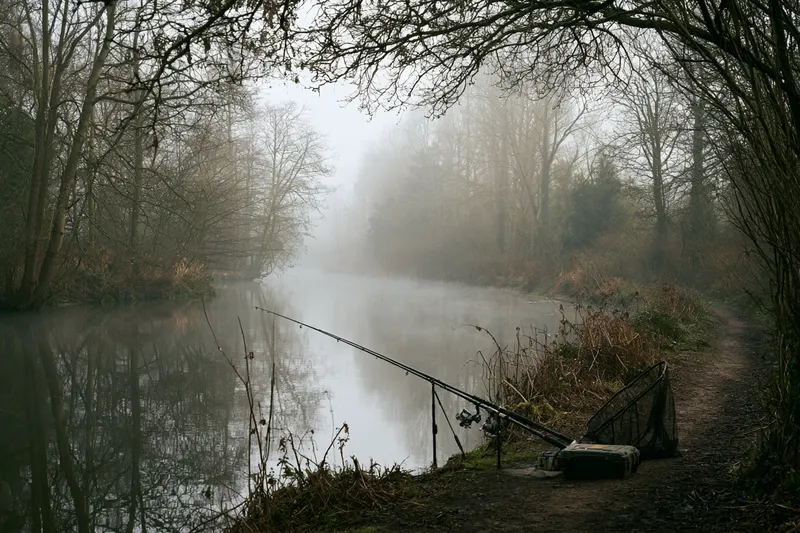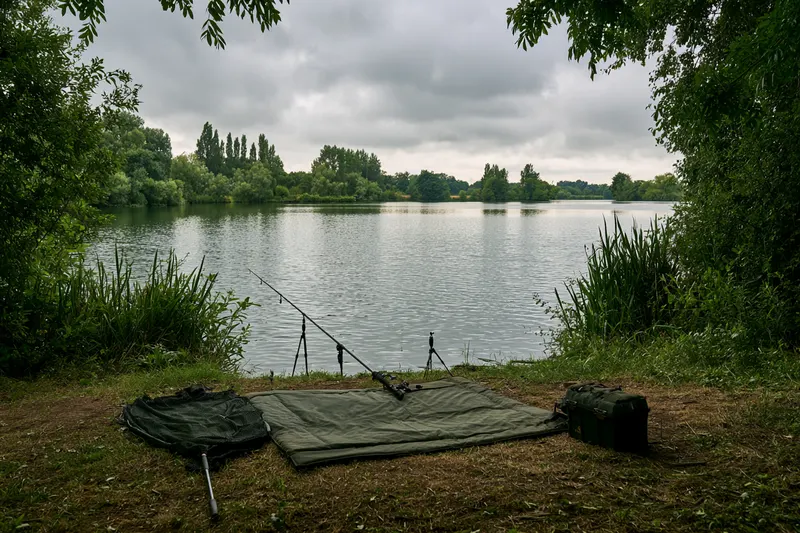
Carp are among the most popular fish in Britain because they are fairly easy to catch and fight hard. That power is also why beginners need slightly stronger tackle, a safe rig and a plan for looking after the fish once it is on the bank.
Know your quarry
The common carp is not native to Britain: it was introduced in the 13th or 14th century as a food fish. Selective breeding produced three familiar forms: the fully scaled common, the partly scaled mirror and the almost scaleless leather carp. The Canal & River Trust gives a typical length of 40 to 100cm.
Carp feed mostly on the bottom, on water fleas, midge larvae, worms, snails and mussels. In warm, sunny weather they often bask near the surface, which is when floating baits come into their own.
Choosing a venue
Carp live in weedy ponds, flooded gravel pits, lakes and most canals. For a first session, a well-stocked stillwater with clear rules and easy access is the gentlest start. Canal carp are described by the Canal & River Trust as a challenge, so they are better saved for later.
Look for features: carp like overhanging trees, reed beds and the far bank. Whatever the water, you need your own rod licence as well as the fishery's ticket or permit.
A basic setup
Match the tackle to the water. Weedy or snaggy swims call for stronger line and a larger hook than open water. One council-run fishery, Black Park in Buckinghamshire, sets its carp minimum at 12lb line, a landing net of 36 inches or more and a large, well-padded unhooking mat, which is a sensible benchmark.
Beginner carp kit
- Rod licence and fishery ticket
- Rod, reel and 12lb+ main line
- Landing net, 36in or larger
- Large, well-padded unhooking mat
- Lead clips, tail rubbers and swivels
- Barbless hooks
- Pellets, boilies, bread or dog biscuits
Baits that work
Smaller carp will eat almost anything on the hook. The Canal & River Trust names pellets and boilies among the favourite baits, and notes that carp can often be caught near the surface on bread or dog biscuits. Bread can also be fished under a float, a method explained in our guide to float fishing for beginners.
A simple, safe rig
The safety rule matters more than any rig trick: if your main line breaks, the lead must be able to come free, so a hooked fish is never left towing a weight. A lead clip with its tail rubber pushed on only lightly does this, and the hooklink should be weaker than the main line.
Tying a safe lead-clip rig
- Thread onSlide a tail rubber onto the main line.
- Tie the swivelFit the lead clip and tie the main line to the rig swivel.
- Pin the clipPush the supplied pin in to hold the clip on the swivel.
- Add lead and hooklinkClip on the lead, then tie a hooklink weaker than the main line.
- Rubber on lightlyPush the tail rubber only lightly onto the clip.
- Test itCheck the lead pulls free with minimal effort.
Many fisheries ban fixed leads and unsafe rigs outright. If you change a rig, check the lead still ejects with minimal effort before you cast it.
Landing and unhooking
Stay with your rods. By law you must not leave a rod and line unattended in the water, and when fishing several rods the outer butts must be no more than 3 metres apart.
From bite to release
- Strike and playKeep steady pressure and steer the fish away from snags.
- Net itDraw the carp over a large net rather than lunging at it.
- Onto the matPlace it on a large, padded, wet unhooking mat.
- UnhookRemove the barbless hook gently, keeping the fish low.
- Return quicklyRelease the carp promptly and let it swim away.
Keep handling to a minimum and keep the fish low over the mat, so it cannot fall far if it flaps. Many anglers also wet the mat with lake water before use, and return the carp as soon as it is unhooked.
Respect the fishery rules
Every water has its own rules, and they can be stricter than the law. Typical examples include barbless hooks only, a two-rod limit, no keepnets or carp sacks, no night fishing and no pre-baiting. Read the notice board or permit before you start.
Start on a well-stocked stillwater, use strong enough line and a big net, fish a rig whose lead can come free, and unhook every carp on a padded mat before returning it quickly.
Sources
- Carp (Canal & River Trust) — Carp types, size, diet, habitat, history and favourite baits.
- Black Park fishing rules (Buckinghamshire Council) — Example fishery rules: 12lb line, 36in net, padded mat, barbless hooks, no fixed leads, no keepnets or sacks.
- The safe bolt rig (Angling Times) — Lead clip and tail rubber components, lead must slide free, hooklink weaker than main line.
- Freshwater rod fishing rules: tackle you can use (GOV.UK) — Unattended rods, 3m between rod butts, keepsack and landing net rules.